Lengthy Story "Without struggle, no progress and no result" George Gurdjieff, philosopher, spiritual teacher. "The way of all peace is to scale the mountain of Self" 1st Tenet, Novus Spiritus “Every man is born
with aptitudes which give him access to vital and formative knowledge by one of these roads; either by the road of
studying man and his works, or by the road of studying nature and her works. The business of instruction is
to seize and develop these aptitudes. The great and complete spirits which have all the aptitudes for both
roads of knowledge are rare.” Dr. Earnest
Holmes, founder of Religious Science (a New
Thought ‘religion’) believed that Science, Religion and Philosophy could be brought
together. Science and religion are often viewed as antagonists in the quest for truth. A conflict
of truths with origins in as far as antiquity: tension between Athens, ancient well-spring of
secular philosophy, and Jerusalem, the symbol of revealed religious truth. As for truth, Anne Lamott, in her book, “Bird by Bird: Some Instructions on Writing and Life", discusses how to get at the truth by staying in the present moment and paying attention. She calls this the “writing frame of mind”: “Writing is about learning to pay attention and to communicate what is going on. Now, if you ask me, what’s going on is that we’re all up to here in it, and probably the most important thing is that we not yell at each other. Otherwise we’d all just be barking away like Pekingese: “Ah! Stuck in the shit! And it’s your fault, you did this…” Writing involves seeing people suffer and, as Robert Stone once put it, finding some meaning therein. But you can’t do that if you’re not respectful. If you look at people and just see sloppy clothes or rich clothes, you’re going to get them wrong.” Spiritual Discovery Ascend: Matter to Spirit (Transcendent -
Divine in the immaterial world). The Many to One. The
path of wisdom. Transcendent philosophy is situated within eternal reality, whereas Immanence philosophy is based within temporal reality. That Spirit is the ultimate reality and that man and women have a ‘spark of the divine’ within them. That the God or Spirit outside of us is 'transcendent' and God inside us is 'immanent'.
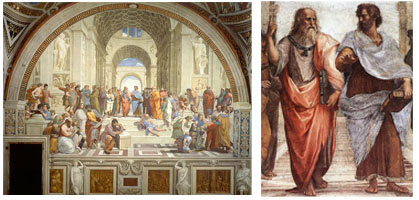
In the secular philosophical view, we see the two grand movements depicted in Raphael’s painting (1510), The School of Athens. Plato (left) is pointing up representing the ‘generalities’ and his belief in the Forms (Ideals). This is the ascendant drive: matter to spirit. On the right, Aristotle is pointing down, representing the ‘particulars’ and his belief in knowledge through empirical observation and experience. This is the descendant drive: spirit to matter. In A Brief History of Everything, Ken Wilber, eminent American philosopher, summarizes the religious-spiritual view of these two grand movements: “The war between Ascenders and the
Descenders has been one of the central and defining conflicts in the Western mind. Beginning with
Augustine, the Ascenders and the Descenders
were in relentless and often brutal conflict, and this saddled the West with two completely incompatible
Gods. Mr. Wilber elaborates on this via the “Father-Mother God” principle: "If we
ignore for the moment the more provincial and stage-specific notions of the horticultural Great Mother
as farming protectress, and the agrarian images of God the Father as a Big Daddy in the Sky – these mythic images
are not very useful for an overall picture – and if you look instead to the broad understanding of God and Goddess
(Father-Mother God) then the balanced picture that emerges is something like this: The Golden Seat seeks to harmonize both the Ascending and the Descending movements. To embrace the healthy and heal the unhealthy. To not be repressive and at the same time to not be regressive (ie, to go back to the ‘acorn’ – some imagined ‘pristine’ state of nature; that the ‘oak tree is somehow a horrible violation of the acorn’). When, Jesus Christ of Nazareth, said, “Seek and
you shall find. Knock and it shall be opened unto you” (Matt. 7:7), He was speaking of Spiritual
Discovery. All the major spiritual leaders, Jesus, Buddha, Muhammad, were aware that humankind is engaged in a process that leads us toward higher understanding
of ourselves, the world and God. To achieve a higher understanding of our Lord, we
reexamine His major themes: In his book, "I Love Jesus, I hate Christianity", Kim Michaels tells us: “Because we have greater understanding of the material world and human psychology today that was the case 2,000 years ago, we also have the foundation for receiving a deeper understanding of the spiritual side of life. When our Lord said ‘I have yet many things to say unto you, but ye cannot bear them now’ (John, 16:12), his purpose was to come to the people of his time to overcome their spiritual blindness. Some Christians will say that the leadership of their church is in communion with Christ and is constantly being led by him. However, for the past 2,000 years no mainstream Christian church has been willing to recognize any new revelations (truths) from Jesus. The vast majority of Christian churches affirm the belief that Jesus has had not to say to humanity beyond what he said in the official scriptures…I believe Jesus came to this planet partly to call us to change our view of God so that we could develop a more mature and sophisticated relationship to God. Human beings have an element in psyches that resists change, and this element cause us to be blind to the necessity for change. When we suffer from this spiritual blindness, we tend to reject the messengers of change that God sends to us. It is through understanding and knowledge that will empower us to overcome the resistance to change.” At the conclusion of her book, "Beyond Belief", Elaine Pagels, Professor of Religion at Princeton University, writes: “We have also seen the hazards—even terrible harm—that sometimes result from unquestioning acceptance of religious authority. Most of us, sooner or later, fine that, at critical points in our lives, we must strike out on our own to make a path where none exists. What I have come to love in the wealth and diversity of our religious traditions—and the communities that sustain them—is that they offer the testimony of innumerable people to spiritual discovery. Thus they encourage those who endeavor, in Jesus’ words, to ‘seek and you shall find.’ “ Higher
Knowledge It is difficult to live in ignorance, to be guilty of ignorance, but looking at that positively, this guilt helps us to hone our senses. We are all human. It is a terrible strain to aim be perfect. It is a terrible burden to be always right, always wonderful, always great, always perfect. And we do get audited – for that makes us an example for others. Tenacity is a great trait, for if we do not give up we will succeed. If we keep on going regardless of personal struggles or barriers (lack or over-abundance of money, unearned moral superiority, addictions) we will win. When we rise above ignorance, we have less pettiness to deal with. The aim to ‘rise above ignorance’ is also found in an ancient Buddhist text: "The noble truth deals with the cause of
all suffering, which is clinging or grasping. It is a futile grasping of life based on the wrong point of
view, which is called ignorance. Out of this ignorance we divide the perceived world into individual and
separate things and thus attempt to combine all the reality into fixed categories created by the mind. As
long as this view prevails, we are bound to experience frustration after frustration, trying to cling to things and
people which we see as firm and persistent, but which, in fact, are transient and every changing. Sources of Knowledge The figures within The Golden Seat are people and Angles. And its key proposition is that Angels exist. If you ask people who truly believe in angels “how do you know they exist?”, they’ll confidently say, “I don’t have to prove it, I just believe”. Some philosophers will use the classic Theories of Truth to argue the question of belief. In his integral-style book The Good, the True and the Beautiful – A Quest for Meaning, Michael Boylan, professor of philosophy at Marymount University, discusses the limits of rational analysis: ‘…rationality seeks to demonstrably to prove all propositions [eg,”the sum of the interior angles of a triangle is 180 degrees” to “God Exists”]. In cases in which there is no empirical test for verifying a principle, all the best reason can do is to offer various plausible alternatives. The resolution can only come about through appeal to the personal worldview imperative.” Boylan's arguments are based from a Source of Knowledge from an immanence standpoint (temporal reality – memory, observation, perception). Because “St. Patrick said so”, the churchman or churchwoman and his/her flock took it on blind faith that the Holy Trinity is "one God in three divine persons" (St. Patrick's 'three-leaf clover' analogy as told to children). Modern Metaphysical Spirituality takes a transcendent view of the divine. It is almost a knowing that angels exist (and, for that matter, that God exist). In Ken Wilber’s lexicon, ‘personal worldview imperative’ is the Upper Left Quad – that of the individual and his or her’s interior awareness – the ‘intentional’ of AQAL. Interior awareness is the home of intuitive knowledge: ‘vibrations’; ‘ to feel in one’s ‘bones’; ‘gut feeling’; ‘ a hunch’ – BELIEF. The highest source of knowledge transcends propositional philosophy which seeks to understand by exploration and investigation and to reach conclusions by reason rather than by intuition. With intuition it is difficult to communicate what is or an inner knowing because it is internal to oneself. Interpretation of experiences and thoughts is required; thus we say “you know what I mean?” when we try to explain something personal or intuitive to a friend or colleague. The pure externalists (logical thinker in the empirical-rational deductive camp) will object to the intuitive stance. The intellectualist insist on logical deductions to prove something. However, in regards to Belief, the logical thinker must acknowledge that ‘to grasp the basis of phenomena through logical thought may be impossible since logical thought is itself a part of the phenomena and wholly involved in them.’ Sometimes an image communicates an idea better than a rational explanation (even though its ‘fitness’ cannot be strictly proven). Going back to Belief, an endearing picture would be the lovable grandmotherly‘Oracle’ of the movie The Matrix, of who we could ask, “do angels exist? ”. Our ‘heart of hearts’, would expect her to reply, “of course my dear, and when you leave this room you’ll feel right as rain”. Of course, there are non-believers who don’t believe that angels exist. And that is all perfectly well, for one can still enjoy the beauty of a Chagall painting and yet not believe in ‘flying angles’. A ‘Win-Win’
Philosophy Besides Spiritual Discovery and Higher Knowledge, another ‘Frame of Mind’ of the Golden Seat is the belief in a ‘Win-Win’ philosophy. In his ground-breaking book, Nonzero, author Robert Wright discusses the overall benefits non-zero-sum solutions: “Non-zero-sumgames, unlike
zero-sumgames, can have “win-win” outcomes. People sometimes think of them as orgies of amiability, they can
be, but they usually are not. Almost always, with a non-zero-sum game, there is a dimension of zero-sumness – a
conflict of interest. The ‘non-zero-sum’ philosophy can be applied to religious tolerance in that tolerance is more likely when you see yourself as losing from intolerance, regardless of whether the situation seems zero-sum or non-zero-sum. When the situation is seen as non-zero-sum, when both sides see themselves losing, then mutual tolerance makes sense. Throughout the ages history has shown that people with other world-views had to come together for mutual gain. A principle in motion since antiquity: the championing inter-faith tolerance and mutual respect. When people face win-win situations and think they can work together, they are open to one another’s worldview, not to mention one another’s continued existence. To share a stake in the success. An economic example of a ‘lose-lose’ mentality is when labor leaders view markets as closed - someone’s got to lose for another to win. In his presidency, Bill Clinton commented on the value of holding a Win-Win philosophy: “But in game theory, a zero-sum game is one where, in order for one person to win, somebody has to lose. A non-zero-sum game is a game in which you can win and the person you're playing with can win, as well. And the argument of the book is that, notwithstanding all the terrible things that happened in the 20th century--the abuses of science by the Nazis, the abuses of organization by the communists, all the things that continue to be done in the name of religious or political purity--essentially, as societies grow more and more connected, and we become more interdependent, one with the other, we are forced to find more and more non-zero-sum solutions. That is, ways in which we can all win.And that's basically the message I've been trying to preach for eight years here...We have to have an expanding idea of who is in our family. And we in the United States, because we're so blessed, have particular responsibilities to people not only within our borders who have been left behind, but beyond our borders who otherwise will never catch up if we don't do our part. Because we are all part of the same human family, and because, actually, life is more and more a non-zero-sum game, so that the better they do, the better we'll do.” (Applause) Nonzero is a sort of a reverse social Darwinism: the more complex societies get and the more complex the networks of interdependence within and beyond community and national borders get, the more people are forced in their own interests to find non-zero-sum solutions. The pressing goal for a healthy future is to find win-win solutions instead of win-lose solutions. President Clinton continues to discuss the argument for a non-zero outlook: “…to succeed, even in positions of
leadership, where there is a competition for the position, the measure of success is not so much whether you won at
somebody else's expense, but whether you got what you wanted because you enabled other people to achieve their
dreams and to do what they want.” z
|